
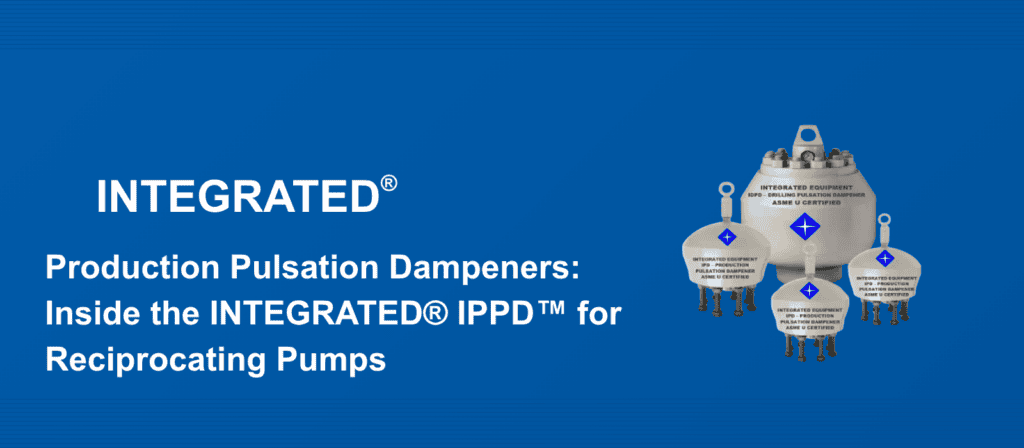
Production, disposal and pipeline systems run on reciprocating pumps — and like any reciprocating pump, they move fluid in pulses, not a smooth stream. Each stroke sends a pressure spike through the line that wears the pump, loosens fittings, shakes the piping and unsettles instruments. On the production side, the unit that smooths those spikes is the INTEGRATED® Production Pulsation Dampener (IPPD™).
This post is about production service specifically — where the IPPD™ is used, what makes it suited to corrosive and disposal duty, and how it is sized and maintained. For the basics of what a pulsation dampener is, see our overview of INTEGRATED® Pulsation Dampeners.


Where the IPPD™ Is Used
The IPPD™ is built for reciprocating pumps across production and midstream operations. Typical duties include:
Production pumping — suction and discharge service, and fluid-end pumping.
Saltwater disposal and injection — handling produced water and disposal fluids.
Pipeline — steadying flow and pressure along the line.
Beyond oil and gas — mining, petrochemical and reverse-osmosis systems that run reciprocating pumps.
How the IPPD™ Works
The IPPD™ is an accumulator. A gas cushion — nitrogen — sits behind a flexible diaphragm, pre-charged to suit the operating pressure. As each pump stroke sends a surge into the dampener, the gas compresses to absorb it, then expands between strokes to push the fluid back out — smoothing the peaks into steadier flow. INTEGRATED® designs its pulsation dampeners for a high pre-charge capability, delivering a minimum 85% reduction in peak-to-peak pressure.
Built for Corrosive and Disposal Service
What sets the IPPD™ apart on the production side is how it handles aggressive fluids. Standard applications include waste disposal, saltwater injection and caustic products, along with other corrosive liquids — exactly the duty that punishes ordinary equipment.
Two design features matter here. The isolated body cavity keeps the pumped fluid contained within the diaphragm, so it is not sitting against the vessel body. And the diaphragm itself is chosen to match the fluid: NBR (Nitrile Butadiene Polymer) as the baseline, HNBR (Hydrogenated Butadiene Polymer) for higher temperatures and sour service, and FKM (Fluorocarbon Polymer) for the most chemically aggressive environments. Matching the compound to the fluid is what keeps the unit reliable in corrosive service.
For more information on how these compounds are selected, see our guide to INTEGRATED® Elastomers for oil & gas pressure control.
Compact Design
The IPPD™ has a short, compact design that requires no external bracing or other support structures. On crowded production skids and tight surface layouts, that makes it far easier to install and integrate — the dampener carries itself rather than needing a frame built around it.
Specifications and Sizing
Selecting the right IPPD™ is a technical decision, not an off-the-shelf pick. The choice depends on the flow rate and operating pressure of the pump, the level of pulsation to be smoothed, and — critically for production service — the fluid being pumped, which drives the diaphragm material and the pre-charge. The gas side is pre-charged to a pressure slightly below the minimum operating pressure of the system. Because getting this right depends on the specifics, INTEGRATED treats selection as a process that calls for knowledge of the pressure system, its components and the fluid — and assists with sizing so the unit fits the pump and service.
Maintenance, Diaphragms and Repair
The diaphragm is the wear part in a pulsation dampener, and INTEGRATED supplies replacement Pulsation Dampener Diaphragms (bladders) in NBR, HNBR and FKM, along with replaceable SS or CS bottom plates and other spare parts — all under INTEGRATED® engineered design and quality control, and backed by a standard manufacturer’s warranty (available on request). INTEGRATED® also offers Pulsation Dampener repair and recertification, so a unit can be returned to standard rather than replaced.
Frequently Asked Questions
What does a production pulsation dampener do?
Fitted on a reciprocating production pump, it absorbs the pressure surges from each pump stroke — steadying flow and pressure and reducing vibration and wear on the pump, valves, fittings and lines.
What fluids and applications is the IPPD™ used for?
Production suction and discharge, fluid-end pumping, pipeline, and saltwater disposal and injection — including caustic and other corrosive liquids. It also serves mining, petrochemical and reverse-osmosis systems.
What sizes and pressure ratings does the IPPD™ cover?
Sizes from 1 to 20 gallon, with pressure ratings from 285 psi to 6,170 psi.
What is it pre-charged with, and to what pressure?
With an inert gas — nitrogen — set to a pressure slightly below the minimum operating pressure of the system, so the dampener works across the full pressure cycle.
What diaphragm materials are available?
NBR (Nitrile Butadiene Polymer), HNBR (Hydrogenated Butadiene Polymer) and FKM (Fluorocarbon Polymer), chosen to suit the fluid and temperature. The diaphragm is a replaceable wear part.
Steadier pressure on production, disposal and pipeline pumps starts with the right dampener for the fluid and the duty. Explore the INTEGRATED® IPPD™, or talk to our team about the right unit for your pump and service.
→ See the IPPD™ production pulsation dampener: integratedwww.com/…/production-ppd-saltwater-disposal
→ Talk to our team: integratedwww.com/contact-us
→ Email: sales@integratedwww.com