
On a well under pressure, a gate valve has one job: open fully when you need flow, and seal completely when you do not. On blowout preventers (BOPs), choke and kill manifolds and wellheads, that job has to be done reliably, at high pressure, for years. The INTEGRATED IFC™ is a field-proven API 6A slab gate valve built for exactly that service.
This post explains what a slab gate valve is and how it works, looks inside the IFC™ — its construction, materials and ratings — and covers where it is used and how it is maintained.
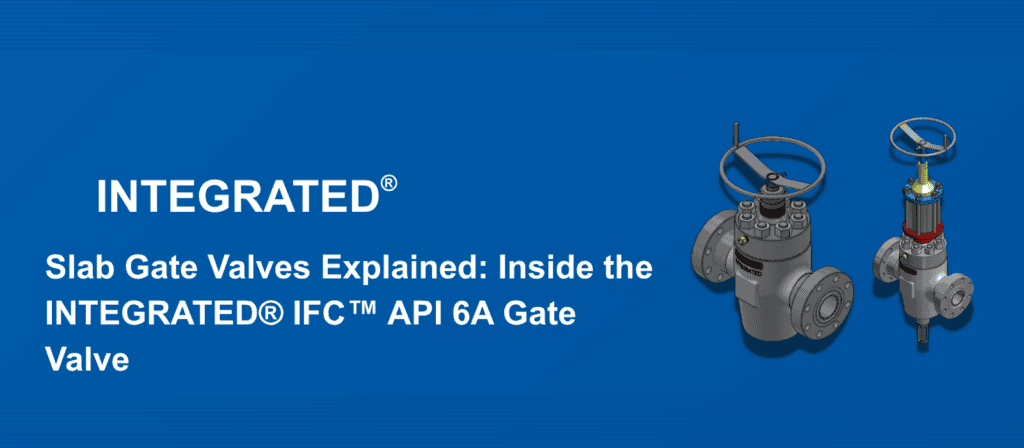
INTEGRATED® IFC™ MANUAL GATE VALVE

INTEGRATED® IFC™ HYDRAULIC GATE VALVE

What the IFC™ Gate Valve Is — and Where It Is Used
The INTEGRATED® IFC™ is a pressure-control gate valve used across oil and gas drilling operations: on blowout preventers, choke and kill manifolds, wellhead valves, and many other applications where reliable, durable performance under high pressure is essential.
It is built for drilling, workover, snubbing and production service, providing flow control equipment – BOP (to API 16A), choke and kill manifolds (to API 6A) and wellhead valves (to API 6A).
How a Slab Gate Valve Works
The IFC™ is a slab gate valve. A single, flat gate slides across the bore to open or close the flow path. In the open position, its full-bore design leaves an unrestricted opening the same size as the line, so fluid passes straight through with minimal turbulence or pressure drop. In the closed position, the gate seals against the seat to shut the line off completely — a gate valve is made for on/off isolation, not for throttling flow.
Two design choices make the IFC™ well suited to well-control service. It uses a non-rising stem, so the stem rotates to move the gate without travelling up and out of the valve — useful where vertical space is limited. And it uses a floating slab gate and seat, which lets the gate settle against the seat to form the seal.
Inside the IFC™: Design and Construction
The core of the valve is built for strength and integrity under pressure:
- Forged steel body and bonnet — forged (not cast) for structural integrity in high-pressure service.
- Non-rising stem — rotates in place to drive the gate, keeping the overall envelope compact.
- Floating slab gate and seat — the single-piece slab gate and its seat form the metal-to-metal seal.
- Full-bore design — an unrestricted, line-size opening for full flow when open.
Materials, Coatings and Temperature Range
Because a well-control valve sees pressure, wear and corrosive fluids, the IFC™ is available with upgraded metallurgy and coatings:
- Ring grooves and seat pockets — available with SS316 inlay or Inconel 625 cladding for corrosion resistance.
- Gate and seats — tungsten-carbide-coated gate and solid Stellite seat rings for wear and abrasion resistance.
- Grease fittings — Inconel, for performance and temperature endurance.
- Stem — MOS2-coated for lower operating torque.
- Bonnet bolts and nuts — zinc- or cadmium-plated for corrosion resistance.
- Temperature rating — from -50°F to 350°F.
Standards and Interchangeability
The IFC™ is an API 6A valve, and INTEGRATED® manufactures it under API license. The company’s quality system (QMS) and product credentials include API 6A, 16A, 16AR, 16C, 20E, ASME U, CE & CRN, API Q1 and ISO 9001:2015.
The IFC™ is a field-proven valve designed for reliability and interchangeability: it is built to interchange with existing FC-style valves, so operators can fit it into service without redesigning around it.
Where the IFC™ Fits in the System
The IFC™ works throughout the pressure-control stack — on blowout preventers, on choke and kill manifolds, and as wellhead valves. For the wider picture of where these valves sit in well control, see our overview of INTEGRATED® Blowout Preventers.
Maintenance and Repair Kits
A gate valve earns its value over a long service life, and that depends on maintenance. INTEGRATED® supplies minor and major valve repair kits for the IFC™, so seats, seals and stem components can be renewed and the valve kept in service rather than replaced.
Frequently Asked Questions
What is a slab gate valve?
A gate valve that uses a single, flat (slab) gate sliding across the bore to open or close the line. With a full-bore design, it gives an unrestricted, line-size opening when open, and a metal-to-metal seal when closed.
What does “non-rising stem” mean?
The stem rotates to move the gate but does not travel up and out of the valve as it operates — which keeps the valve compact and is useful where vertical space is limited.
What is the difference between a gate valve and a ball valve?
A gate valve moves a gate in a straight line for clean on/off isolation and, when full-bore, unrestricted flow. A ball valve uses a quarter-turn ball. Gate valves are made for full-open or full-closed service rather than throttling.
What is the IFC™ temperature rating?
From -50°F to 350°F.
Is the IFC™ interchangeable with FC-style valves?
Yes. The IFC™ is field-proven and designed to interchange with existing FC-style valves.
IFC™ gate valve, or talk to our team about the right configuration for your application.
→ See the IFC™ gate valve: integratedwww.com/…/ifc-valve
→ Talk to our team: integratedwww.com/contact-us
→ Email: sales@integratedwww.com