
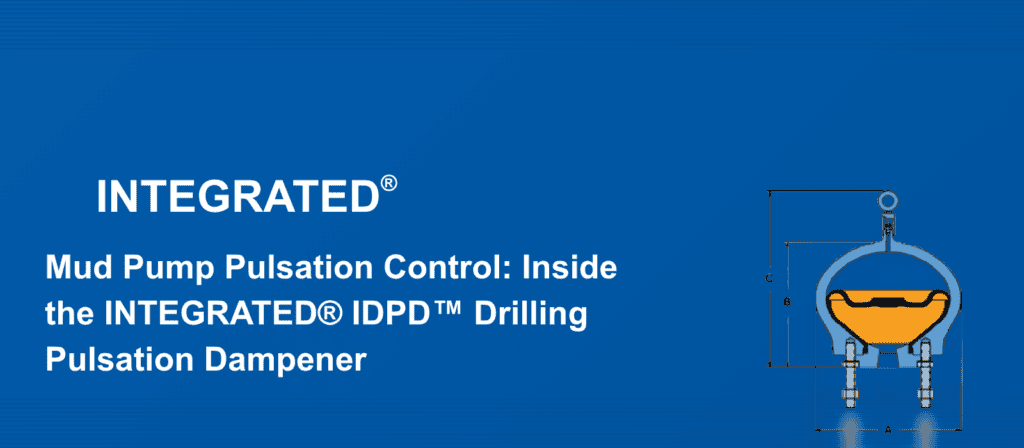
A drilling rig’s mud pump is a reciprocating pump, and reciprocating pumps do not push fluid in a smooth stream — they deliver it in pulses, one per stroke. On a high-pressure mud line, those pulses translate into pressure spikes and vibration that wear the pump, shake the standpipe and lines, and unsettle gauges. The equipment that dampens the continuous pulsations is the INTEGRATED® IDPD™ Drilling Pulsation Dampener, fitted on the mud-pump discharge.
This post looks specifically at drilling service — how the IDPD™ works on a mud line, its specifications, pre-charging, and how it is kept running. For the basics of what a pulsation dampener is and how production and drilling units differ, see our overview of INTEGRATED® pulsation dampeners.


Why a Mud Pump Needs a Pulsation Dampener
A mud pump circulates drilling fluid under high pressure. Because it pumps in strokes, each stroke sends a surge down the discharge line. Left unchecked, those surges hammer the pump’s fluid end, valves and seals, vibrate the standpipe and surface lines, and make downhole and surface pressure readings jump around.
Installed on the discharge, the IDPD™ absorbs those surges at the source. The result is steadier flow and pressure, less vibration through the system, and reduced wear on the pump and everything downstream of it — which is why a discharge pulsation dampener is standard on drilling mud pumps.
How the IDPD™ Works
The IDPD™ is an accumulator. A gas cushion — nitrogen — sits behind a flexible diaphragm, pre-charged to suit the operating pressure. As each pump stroke sends a surge of mud into the dampener, the gas compresses and absorbs the energy; between strokes, it expands again and pushes the fluid back out. That cycle smooths the peaks and troughs into a steadier flow.
INTEGRATED® designs its pulsation dampeners for a high pre-charge capability, which delivers a minimum 85% reduction in peak-to-peak pressure — a large cut in the pressure swings the rest of the system must absorb.
IDPD™ Specifications
Pre-Charge and Getting the Setting Right
A pulsation dampener only performs when its gas pre-charge is set correctly for the system. Pre-charge is matched to the operating pressure of the mud line, and the IDPD™ uses a fully enclosed and protected charging valve assembly so the gas side stays secure in service.
Because the correct setting depends on the specifics of the pressure system, selecting and setting a dampener is a technical decision — it calls for knowledge of the pressure system, its components and the fluid being pumped. INTEGRATED® assists with sizing and setup so the unit matches the pump and service.
Sizing an IDPD™ for a Mud Pump
A pulsation dampener is matched to the pump and the line, not picked off a shelf. The right unit depends on several factors working together: the flow rate and operating pressure of the mud pump, the type of pump (for example, the number of cylinders, which shapes the pulsation pattern), and the dampener volume needed to smooth the pressure swing to the level required. The fluid itself matters too, because it drives the diaphragm material choice.
The IDPD™ is offered from 10 to 20 gallon and from 5,000 psig to 7,500 psi, so the unit can be matched to the mud pump’s duty. Because getting this right depends on the specifics of the system, INTEGRATED® treats selection as a technical process — one that calls for knowledge of the pressure system, its components and the fluid — and assists with sizing so the dampener fits the pump and service.
Built for Drilling Mud: The Diaphragm
Drilling mud is abrasive and carries solids, so the diaphragm is the part that earns its keep. The IDPD™ diaphragm is engineered for that duty:
Stabilizer-equipped — the diaphragm has a stabilizer that prevents folding and fluid entrapment, which increases diaphragm life.
Field-replaceable — the diaphragm can be replaced without removing the unit from the line, cutting maintenance time.
Matched to the fluid — available in NBR (Nitrile Butadiene Polymer), HNBR (Hydrogenated Butadiene Polymer) and FKM (Fluorocarbon Polymer), selected for the mud and temperature.
Every elastomer component — original or replacement — is under INTEGRATED® engineered design and quality control. For more on how these compounds are chosen, see our guide to INTEGRATED® elastomers for oil & gas pressure control.
Safe, Reliable Operation
A pulsation dampener is a pressure vessel, so how it is built and maintained matters. The IDPD™ is ASME U code stamped, with CE, CRN, ABS and DNV certifications available. Its charging valve assembly is fully enclosed and protected, and its diaphragm is designed to resist folding and fluid entrapment.
Safe operation also comes down to how the gas side is charged. The pre-charge uses an inert gas — nitrogen — rather than compressed air, since air introduces oxygen on the gas side of a high-pressure vessel. Beyond that, reliable service is a matter of the basics done right: the correct pre-charge for the system, the right diaphragm material for the fluid, and regular inspection. When a diaphragm reaches the end of its life, using OEM-engineered replacement parts keeps the unit performing as designed.
Maintenance, Diaphragms and Repair
Because the diaphragm is field-replaceable without pulling the unit off the line, routine maintenance is quick. INTEGRATED® supplies OEM replacement diaphragms and parts under its engineered design and quality control, backed by a standard manufacturer’s warranty (available on request), and offers pulsation dampener repair and recertification to return a unit to standard rather than replacing it.
Frequently Asked Questions
What does a mud pump pulsation dampener do?
Fitted on the mud-pump discharge, it absorbs the pressure surges created by each pump stroke — steadying flow and pressure and reducing vibration and wear on the pump and downstream equipment.
How does the IDPD™ work?
It is a gas-pre-charged accumulator: nitrogen behind a diaphragm compresses to absorb each surge and expands between strokes, smoothing the flow. INTEGRATED® dampeners are designed for a minimum 85% reduction in peak-to-peak pressure.
What sizes and pressure ratings does the IDPD™ cover?
Sizes from 10 to 20 gallon, with pressure ratings from 5,000 psig to 7,500 psi.
Can the diaphragm be replaced in the field?
Yes. The IDPD™ diaphragm is field-replaceable without removing the unit from the line, which reduces maintenance time. A built-in stabilizer helps extend diaphragm life.
Why is it charged with nitrogen rather than air?
The gas side is pre-charged with an inert gas — nitrogen — because compressed air introduces oxygen into a high-pressure vessel. Nitrogen is the standard choice for pre-charging pulsation dampeners.
What diaphragm materials are available?
NBR (Nitrile Butadiene Polymer), HNBR (Hydrogenated Butadiene Polymer) and FKM (Fluorocarbon Polymer), were selected to suit the drilling fluid and temperature.
Steadier mud-pump pressure starts with the right dampener, correctly sized and set. Explore the INTEGRATED® IDPD™, or talk to our team about the right unit for your mud pump and service.
→ See the IDPD™ drilling pulsation dampener: integratedwww.com/…/drilling-dpd
→ Talk to our team: integratedwww.com/contact-us
→ Email: sales@integratedwww.com